May 9, 2019

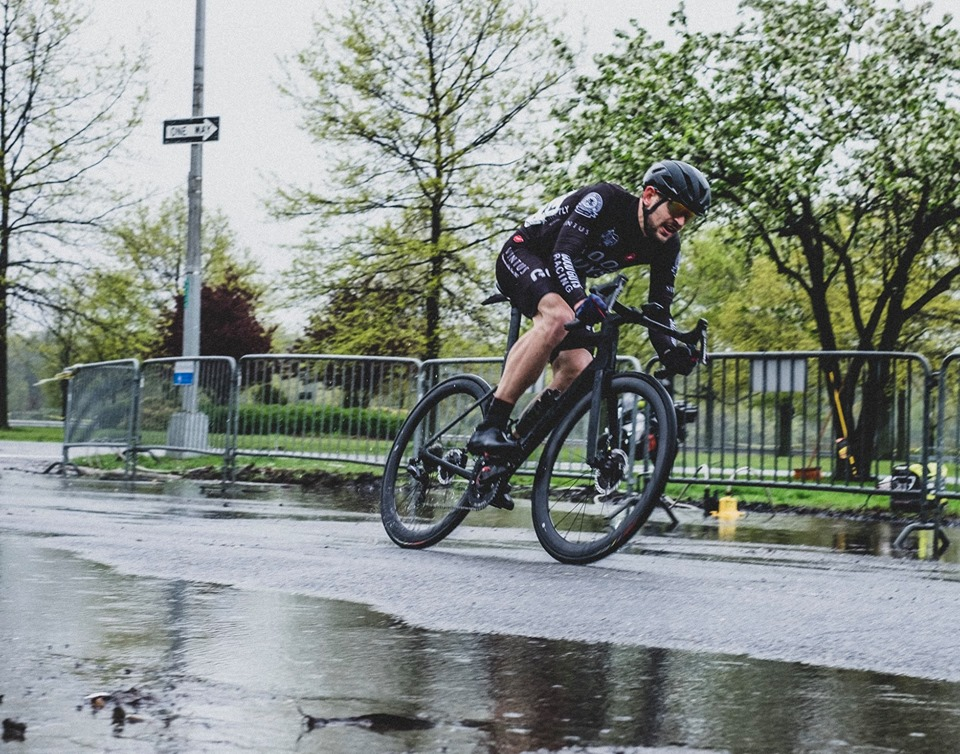
CRCA Zach Koop Memorial Crit at Orchard Beach Park 2019

Hey Readers, sorry for the long hiatus from posting about bikes, racing and PT/Bike-Fit, but hopefully I can get back into a more regular posting schedule. Also, hopefully this race report will keep you entertained!


Men's Cat 2/3 Race
Per my Cat 3 teammate Cormac Daly (who just finished 2nd place in the Men's 3/4 race after his Di2 malfunctioned and he had to sprint from the 53/25) and watching the early races, today the chance of a breakaway win were big; It was cold, wet and windy, meaning that most racers were just trying to survive the race rather than compete for the win. The course was such that there was a solid cross-headwind on the finish straight and a cross-tail on the opposite side, along with the wet roads limiting the corners to a roughly controlled speed.

I made sure to be along the front right away, and sure enough a solid break of 4-5 formed pretty quick - Myself, Ben G (Blue Ribbon), Aaron B (NE Devo), and some dude in Rapha kit, and I think there was someone else who was there briefly. We pushed a few laps and then the Rapha guy pulled the plug, leaving the 3 of us. We were working together ok, although I was yelling at the other guys to keep their pulls smooth and to keep going hard to keep the pace up. I could see from looking across the center of the course that Bastien (Huge engine racing for E2Value) had jumped off the front of the pack, and saw he had someone working with him/hanging on, but couldn't make out the kit and I was more focused on keeping our pace going and trying to prevent the bridge.

Unfortunately Bastien eventually caught on and now it "seemed" like there were 4 of us trading pulls. We slowly caught the field and I quickly moved up through it figuring I might be able to sneak away again while the others sat in the field, unfortunately Bastien, Ben and Aaron all quickly were back with me and we were pulling away from the front of the field. After a lap or so, Bastien put in a deep pull and started pulling away. I was yelling at Ben and Aaron to keep the wheel and they both looked at me drained, so I had to jump solo. I was slowly working back to Bastien's wheel for the next 2 laps when he sat up and I assumed he realized we had a gap and was ready to work together, although as I caught him I heard him swearing and coming to a stop - he flatted his rear tire.

I was roughly 1/2 lap in front of the field with 15ish laps left, so I put the head down and fell into a smooth rhythm: 400-430ish watts into the wind, smooth top corner, 360-380ish with the wind down the back stretch, smooth corner, repeat. While working I would catch a look across the infield to see my progress (along with my teammate Mike yelling gaps at me from the sidelines) and was slowly adding time before I could tell the field lost interest and slowed down.

I caught the back of the field with about 5 to-go and realized I should just sit there safely off the back and easy pedal the last laps rather than get caught out in any scrum at the front - my win was already secure. With 2 laps to go, my teammate Conor jumped hard off the front of the pack - I assumed this was securing 4th place, and was surprised no-one even tried to go with him. He built a solid gap and held it to the line - only afterwards did I learn he was the hanger-on to Bastien's bridge earlier and he was also 1-lap up on the field like Ben and Aaron, meaning he had effectively locked up 2nd place without any sprinting at the line! I rolled in to the finish on the back and happily took the big W, and it was sweet to share the podium with Conor going 1-2 in the race!


Men's P/1/2/3
Lining up an hour after the finish of the 2/3 race, this one was a "see what you can still do" type effort - my legs were definitely a bit tight and I was a bit chilly from the weather, so I figured the good bet was to again stick toward the front and try to warm-up through some efforts. Right off the bat there were attacks and I just worked to stay in the front of the race and defend my position. After a few laps I was feeling better, however the legs were definitely still a little tired. I did a good job of holding my position and suddenly I was in a break with a gap on the field - Alejandro (Foundation), Margarite (Jamison), Myself, and a dude from Bike Habitat.

Our little group actually fell into a good rotation with everyone putting in decent efforts - the Bike Habitat guy definitely did the weakest/shortest pulls and also took the corners the slowest, so I noted he was likely the weakest link in our group and tried to avoid being on his wheel in case he accidentally opened a gap or ate it in a wet corner. We continued to pull away from the field and spent the majority of the race 1/2 lap up. This continued, with me making sure to meter efforts, but also ensure we stayed away.

Once the lap numbers popped up, I figured we were gold, and with around 10 to go, we were actually starting to close in on the back of the field. Realizing that Foundation and Jamison had guys in the field that could help those guys, I reduced my efforts quite a bit to make sure the gap to the field stayed open, leaving it to just be us four. I started really trying to get the right layout with 3 to go, and with 1 lap remaining, the positioning really started to play out. I ended up behind Alejandro going into corner 3 and realized he was going to have to go hard from the corner to have any chance, so I tried to time my jump and catch his tiny draft as well as I could. We were going full-gas up the straight and with about 50m to go, Margarite shot past me, but Ale managed to hold it to the line and I came through in 3rd - not too bad considering the company and having raced earlier in the day. Very happy with the performance and with 2x podiums over the day!

December 9, 2017

Cyclist Strength Training


5 Strength Training Exercises to Integrate Into Your Cycling Training Plan

Strength Training for Cyclists

The demands of being on the bike for extended durations, coupled with constantly turning over the pedals, brings to light the importance of functional strength for cyclists. Functional strength sounds like a bit of a buzzword, but it has real application in the world of endurance sports.
Strength training isn’t often associated with endurance, but we believe there are real benefits to be gained from integrating strength training into your cycling training plan.

Prioritize Your Training to Align with Your Goals

Are you primarily a weightlifter or a bike rider? Prioritize what’s most important. Although strength training has its application in cycling, don’t let the fatigue from your strength training impact the success of your cycling training and compromise your recovery.
This is one reason we recommend spacing your strength training workouts as far apart from your cycling workouts as possible. For example, if you do your cycling workout in the morning, it’s best to tackle your strength training routine in the evening.

Experiment, Experiment, Experiment

If integrating strength training into your cycling is new to you, there is a transition period of becoming accustomed to the shift in training load and emphasis. And like all forms of training, this is a progressive process.
If after a few weeks all you’re noticing is heavier levels of fatigue, it’s time to switch things up. Periodize your strength training much the same as your bike conditioning is periodized. This periodized structure typically follows a progressive structure that can fit nicely in your cycling training plan.

Integrating Strength Training into Your Cycling Training Plan Throughout the Year

The types of strength training you perform will depend on where you are in the Base, Build, and Specialty training phases. Where most cyclists misunderstand strength training’s application is by assuming it is only useful during the off-season. But really, strength training should take place on a year-round basis.
An early adaptive phase and period of max-strength transition training typically occurs in the off-season. Primarily you’ll do most of your strength training in the Base Phase, where your training loads are lighter and important race days are still far down the road. Then when you move into the Build and Specialty Phases, strength training takes a bit of a backseat to the focus on cycling as you move into more of a maintenance phase with your strength training.

Cycling Disciplines that Benefit the Most from Strength Training

While all riders can benefit from reinforced positioning on the bike and improved strength, certain cycling disciplines are likely to see more, or different, benefits than others. An example is to consider is a mountain biker and a time trialist.
It may seem obvious that a mountain biker could benefit from strength training as they navigate technical terrain and physically challenging descents, but even a relatively static discipline like time trialing will greatly benefit from strength training. An aerodynamically efficient position usually comes at the cost of comfort and can be difficult to maintain over time. If you don’t have the strength to hold that aero position, you could be bleeding valuable time.

Strength Exercises for Cyclists

Spiderman Push-Ups

Trunk/core strength, or anything between the hips and the shoulders gains benefit from performing spiderman push-ups. Additionally, an added benefit is the element of hip flexibility attained through bringing each knee to its corresponding elbow.

Pistol Squats

Single leg strength and hip flexibility is the goal of a properly executed pistol squat. Following a progressive approach with the pistol squat is recommended as most athletes will have a difficult time safely executing a full pistol squat.

Side Planks

The core is largely engaged in the side plank, but when including variations on the side plank, you’ll gain the added benefit of increased core, shoulder, and tricep/bicep engagement as well.

Weight Exercises for Cyclists

Deadlifts

Hip and posterior chain strength are the main focus of a proper deadlift. The posterior chain essentially refers to any of the muscles along the backside of the body, meaning deadlifts can be very impactful for solidifying your comfort in positioning. It can be a process dialing in a proper deadlift, so be cautious.

Planking Rows (Renegade Rows)

Rows done in this push-up position integrates strength with stability. With the additional benefit to the “lats” (lattimus dorsi), and core, the ability to sustain proper position on the bike can become more manageable.

Conclusion

There are no hard and fast rules coupling your strength training with cycling training. We have had to experiment with what works, which is what has led us to these conclusions. At the end of the day, we each have individual physiology that accommodates differing rates of adaptation. By listening to our bodies and properly structuring our training, benefits can be gained from an integrated approach to strength and cycling training.

September 6, 2017

Fit Science 1 - Crank Length

Crank length: Forget leverage and power, it’s all about the fit

by Matt Wikstrom
September 6, 2017
Photography by Matt Wikstrom
TECH SUPPORTED BY GIANT
It’s almost inevitable that every road cyclist will start to wonder about the crank length they are using. It’s a topic that is surrounded by a lot of personal anecdotes and opinion, but how much formal testing has been carried out?
In this article, Australian tech editor Matt Wikstrom takes a look at research on the influence of crank length on the performance of road cyclists, and explains that the results are actually quite clear.

There’s no denying the fascination that surrounds cycling equipment. For some, it is a matter of style and/or function; for others, it represents an opportunity for improving their performance. Given that there is a strong competitive aspect to cycling, it’s not surprising that the latter has been responsible for an incredible amount of innovation.
The whole notion of free speed and improved efficiency is compelling in an endurance-oriented sport like cycling. “Marginal gains” has become a popular catch-cry for coaches and bike engineers alike but the compulsion for re-visiting the design of any part of the bike and every piece of kit with the hope of finding free speed is decades old.

Cranksets have received a fair share of this attention. Originally made from steel, they have evolved from largely utilitarian creations to become lightweight and elegant. Aluminium alloy remains the most common construction material, however the last decade or so has seen the successful introduction of composites. The same period has also seen immense proliferation in axle and bottom bracket designs while chainrings have been getting smaller and using fewer bolts.
One thing has remained constant throughout all of this refinement: the length of the crank arms. It has hovered around 170mm since the inception of the safety bike at the turn of the 20th century, and with good reason: it’s long enough to serve as an effective lever yet short enough to remain within the range of motion of the human leg.
At one point, during the dominance of the English bike industry prior to World War II, an attempt was made to standardise crank length (6.5in/165mm) but road racers started to challenge that notion in their quest for an edge. Campagnolo’s new cotterless cranks, introduced in 1958, were distinguished by a generous range of sizes, 165-180mm in 2.5mm increments, and remained so for decades to come.
Interestingly, this range of crank lengths pre-dated much of the formal research on the impact of crank length on a cyclist’s performance. One early study was published in 1953; otherwise it wasn’t until the ‘80s and beyond that the issue was examined with any rigour.
While research on this topic may have been slow to start, it has received a lot of attention over the last 10-15 years and efforts are ongoing. As with any field of research, there has been some contention, and some of the results may run counter to conventional wisdom. I will discuss this in more detail below, but for those hoping for a quick answer, here it is: there is no evidence that crank length has an effect on a road cyclist’s power or speed.

The cranks as a lever

Any debate on the influence of crank length normally starts out by considering the problem in terms of simple physics. When viewed from this perspective, a bicycle crank is considered a lever, and hence, any increase in the length of the cranks has the potential to provide the rider with extra leverage.
While this approach does a lot to simplify the problem, it does not allow for the influence of biomechanics, which, as it turns out, is quite considerable. After all, there are three human-powered joints involved in driving each side of a crankset that require energy in extension and flexion, so there is more to the problem than simply calculating leverage.
Nevertheless, the influence of crank length on leverage for the drive train can be demonstrated under a set of very specific circumstances, namely from a standing start with a fixed gear over a short distance (100-200m). Then, longer cranks allow a rider to develop more speed than shorter cranks, even when the difference is as little as 2mm.
This kind of scenario is quite removed from road cycling, since riders spend most of their time seated and have the freedom to change gear ratios as they please. Under these circumstances, crank length has no effect on maximum power output, and indeed, near-identical results have been observed for a substantial range of crank lengths.
For example, Inbar et al. (1983) measured the mean and peak power output for 13 subjects during a seated 30s effort using crank lengths 125-225mm. While the authors identified an optimal crank length of ~165mm for this kind of effort, there was no significant change in power when cranks were as long as 200mm or as short as 150mm. Beyond that, there was evidence of a small decline in power for 125mm and 225mm cranks, however the losses were relatively small (2-5%).

Martin and Spirduso (2001) essentially repeated this study with 16 trained cyclists for a 3-4s effort and five crank lengths (120/145/170/195/220mm) with very similar results. The researchers noted a small decline (~4%) in power for the shortest and longest cranks, otherwise there was no difference between 145mm, 170mm and 195mm cranks.

Can a change in crank length save energy?

If crank length has no effect on power output for a road cyclist, can a rider save energy by changing the length of the cranks? Research on this question goes back as far as 1953 when Astrand measured oxygen consumption by cyclists riding a bike on a treadmill. Changing the crank length from 160mm to 180mm and 200mm had no effect on oxygen consumption whereas a change of tyres did.
Morris and Londeree re-visited this topic in 1997 with a group of six trained cyclists and found that a small change in crank length (5-10mm) increased oxygen consumption by up to 11% during a lengthy submaximal effort. However, it’s worth noting that the subjects in this study were required to maintain the same cadence (90rpm) for each crank length tested, which may have influenced the effort required.
Indeed, a subsequent study by McDaniel et al published in 2002 clearly demonstrated that the metabolic cost of cycling was largely dependent upon power output, cadence, and pedal speed. A switch between three crank lengths (145/170/195mm) during the course of this study actually had no effect on metabolic cost per se.
Ferrer-Roca et al. (2017) subsequently confirmed these findings with a smaller range of crank lengths (±5mm preferred crank length) while considering the effect on biomechanics, noting that longer cranks increased flexion and the range of movement required at both the hip and knee. This wasn’t the case for shorter cranks, leading the authors to recommend that where there is indecision, cyclists should opt for a shorter crank to reduce the risk of injury.
Wondering what crank length you’re using at the moment? Look on the back of any crank arm to find the length.

Does crank length really need to be optimised?

Based on the evidence presented above and elsewhere in academic literature, there does not appear to be a strong argument for optimising crank length for an individual, at least in terms of pure performance.
But there is more to cycling than simply generating power. There is the demand of maintaining a highly repetitive activity for long periods in the context of fluctuating loads. The bicycle itself is a highly symmetrical machine while the human body is typically asymmetrical, so the potential for uneven loading is enormous and injuries are common.
In fact, a high proportion of cycling injuries relate to overuse for both recreational and professional cyclists. The legs are commonly affected, especially the knees, and while the causes are many and varied, the most common prevention strategy is to modify the rider’s position on the bike.
This is where the optimisation of crank length becomes important. While the position of the saddle can be adjusted to suit the overall reach of the legs, the length of the cranks largely dictates the range of motion. As a result, bike-fitters have come to view crank length as an important parameter that can be optimised for every individual. While this optimisation probably won’t improve the performance of the rider in terms of measurable power, it can add to comfort and prevent injuries.

A formula for deciding crank length?

The current market offers a pretty generous range of crank lengths, starting as short as 160mm and extending to 180mm, often in 2.5mm increments. In addition, there are a few manufacturers offering custom-built cranks outside this range, so it is possible to fit significantly shorter (e.g. 130mm) and longer (220mm) cranks to any given bike. Thus, there are plenty of products available for optimising crank length, but how does a rider to decide on a specific length in the first place?
Longer cranks can make a difference, but only for short sprints from a standing start with a fixed gear ratio.
While it is generally acknowledged that crank length should increase with the height and leg length of the individual, the exact association remains vague at best. One early study (1976) experimented with different proportions of crotch height and concluded that ~20% was the most suitable. Decades later, Martin and Spirduso (2001) arrived at much the same recommendation (20% of leg length).
A variety of other formulae have been proposed over the years ranging from simple equations to more complicated approaches. Each formula is an attempt to describe an association between measurable parameters (e.g. leg length) and a functional outcome based on a finite number of subjects, so a lack of consensus really isn’t surprising. Nevertheless, they have found favour because of the ease they offer, but in strict terms, they do little to settle the matter.
That’s because crank length is part of a system of hinges and levers that must operate in the larger context of an individual’s biomechanics. Most of these formulae fail to consider this at all, effectively isolating the issue from all other considerations, and for this reason, it is probably best to view any result as theoretical at best.
While any of these formulae might provide a starting point for further investigation, it makes more sense to get some advice and direction from an experienced bike-fitter, if only because cranksets tend to be quite expensive.

It’s all about the many aspects of a rider’s fit

Stewart Morton has over 10 years experience as a bike-fitter and he still considers crank length a can of worms. “For the most part, by understanding a rider’s cycling goals and their riding discipline, and assessing their body (flexibility, joint range, injury), I can figure which crank length might be most appropriate.”

“For those in the middle of the bell curve for height then 167.5-175mm cranks will work. The industry has done a pretty good job using anthropometric studies to create bike models with size-appropriate crank lengths,” said Morton.
Thus, in some circumstances, there is no need to change the cranks, and in others, it’s possible to accommodate the rider’s preference for a specific crank length. “Whether a rider runs longer or shorter cranks, I will still aim to get the knee extension and saddle placement neutral to allow injury-free and efficient pedalling.”
Morton also understands that a change in crank length can allow the rider to safely assume a more aggressive position on the bike without discomfort or the risk of injury. “Ironman athletes are running shorter cranks — down to 155mm, in some cases — to help maintain a healthy hip angle as they rotate their bodies around the bottom bracket,” said Morton. “They can move forward and lower the front end of the bike and still make a good transition off the bike for the run.”
Ryan Moody spends his days deciding the final fit for Baum’s custom-built bikes. “I try to put anyone on the longest crank possible within their range of movement to use the muscle mass they have,” he said. “This is especially important for strength-oriented riders. For those riders with greater cardiovascular strength, a shorter crank works better because they tend to ride at higher cadences.”
Deciding on the crank length is not a simple matter, though. The handlebar and saddle position can influence how well the legs are moving, as can the cleat position. Moody’s ultimate goal is to achieve a clean motor pattern for the entire pedal stroke and has found that even minor changes (1-2mm) to the position of a contact point can have a profound effect.

And because he is not working on modifying an existing bike, he is free to customise the geometry of the frame to accommodate each part of the bike, including the cranks. “The bottom bracket height should suit the length of the cranks, especially if they are longer than normal. Putting a long crank (180mm) on a bike with a low bottom bracket will cause problems with pedal strike when cornering.”
Interestingly, Moody also sees crank length as having an effect on the way that a rider can balance their weight on the bike. “A typical male is top-heavy because of their upper-body strength and a longer crank can help them keep it balanced over the handlebars. It’s the opposite for females, who don’t have the same kind of upper-body mass, so a shorter crank is often better.”
Both Morton and Moody are generally happy with the range of crank lengths available and consider 2.5mm increments adequate for their needs. Nevertheless, there may be a growing need for shorter cranks (155-160mm), and not just for Ironman athletes.
“The cycling culture is changing and it’s no longer all about reasonably tall men with lots of leg strength,” said Moody. “A lot of women need shorter cranks for a better fit on their bikes, shorter Asian populations too, but I don’t see crank lengths getting smaller on mainstream bikes yet. These are the kind of riders that are going to benefit most from a change in crank length.”

Summary and final thoughts

The biomechanics of cycling is complex and multi-faceted, so concentrating on a single aspect, like crank length, is bound to suffer from oversimplification and generalisation. Nevertheless, academic researchers have managed to examine this issue with growing sophistication over the last few decades to better understand the influence of crank length on the performance of cyclists.
On balance, the weight of the available research indicates that crank length does not influence the speed, power or efficiency of a road cyclist. What is more important is how the cranks are used, and this is where the training, experience and intrinsic capabilities of the rider make all the difference.
For those riders that have been tempted to try a different crank length based on the promise of extra leverage and perhaps increased efficiency, there are no such gains to be made. The cost of a new crankset will be better spent on formal training with a coach.
By contrast, those cyclists that have been suffering with a recurring overuse injury may find relief with a change in crank length, but this is not something that should be attempted through self-directed experimentation. A trained bike-fitter with extensive experience is likely to take less time and arrive at a more robust solution because they possess the understanding and objectivity to judge a cyclist’s position on the bike.
Author’s note: While links to some of the primary research papers on crank length have been provided in this post, it is far from an extensive review of the literature. In addition, it is not always possible to access original research without a subscription. For those hoping to read more of this research, I’d recommend visiting a university library that has a strong commitment to biomechanics.

September 5, 2017

Cycling Help #1 - Why Bib Shorts?

Why Bib Shorts - By Pactimo

If you’re reading this you could be new to cycling or a veteran cyclist—either way, you’re curious why so many roadies and mountain bikers choose bibs over regular bike shorts.

Making the switch to bibs comes with a certain hesitancy. Not just for new cyclists. Even riders with years of experience and tens of thousands of miles behind them are reluctant to give bibs a try. Why the resistance? Generally, it’s the leotard look of bibs. For some, it’s intimidating to imagine themselves wearing something as silly or dopey looking as bibs.
This article will hopefully shed some light on why so many people love them and why you may never go back to traditional shorts once you’ve make the switch.
cycling bib shorts
Bib shorts are not just regular shorts with suspenders added. That is, however, how they got their start. Racers would yank out the drawstrings and use old-fashioned clip-on suspenders to hold their shorts in place instead. Today, the suspenders are integrated into the short, are not removable, and are designed using Lycra or mesh to be lightweight, breathable and easy on your shoulders.

Here’s a few reasons why bibs are so popular:

1. There’s no waistband.

Since there’s no waistband, there’s also no drawstring or itchy, uncomfortable elastic cutting into your abdomen. You’re less likely to feel as if your blood flow and oxygen intake through deep diaphragmatic breathing is being restricted. Therefore, you’ll feel more productive in the saddle, especially over long distances. Another drawback to the traditional waistband is that they collect and retain moisture, which increases the potential for chafing and overall likelihood of discomfort. Bib shorts will leave you feeling completely free and comfortable in the torso.

2. The chamois stays in place.

Traditional cycling shorts will end up slipping down over time, and that means the chamois, or pad, will shift as well. Keeping the chamois in place will ensure there is less potential for chafing, saddle sores, and generally unhappy times. Bib shorts by nature are designed in a way that guarantees the chamois stays perfectly in place.
Learn more about our 12-Hour Summit Stratos chamois, the endurance-level Summit chamois and the race-level Ascent chamois.


3. Bib straps increase comfort.

As mentioned above, bib shorts utilize lightweight, breathable mesh or Lycra straps over the shoulders. While there are a number of advantages to shoulder straps, the biggest benefit is how they comfortably hold the bib as a whole in place without creating pressure or binding points anywhere on the body. Properly fitting bib shorts should disappear when you are in your natural cycling position. You won’t feel anything tugging, binding or chaffing. Our Summit and Ascent bibs are designed with Silhouette™ Engineering, a natural bend or articulation that mimics the contour of your body when you’re on your bike. This articulation means you experience total and complete comfort when on your bike because of a reduction in fabric bunching.

4. Showing off doesn’t mean showing skin.

The best designed cycling jerseys are shorter in the front to reduce fabric bunching and provide a more aerodynamic fit. For taller riders with traditional shorts that might mean they’ll be sporting the bare midriff when they’re not actually on their bike. With bib shorts being obviously cut higher than a traditional short, a seamless transition between shorts and jersey is maintained at all times. To the onlooker, your bib short and cycling jersey will look just like a jersey and traditional short would; to the wearer though, the difference is as stark as night and day. This is the same from the rear. You won’t ever be tormenting those behind you with an unsightly “plumber’s crack.”
If you’re already a convert to bib shorts you’ll likely agree with the points outlined above. Most cyclists who have converted to bibs have also said they’d never go back to traditional shorts.

September 21, 2014

Cross Revolutions #1 - Silver Lake

  Today was the first race of a brand new CX series here in the Seattle area, an offshoot of the old Seattle CX series. Located at the beach of Silver Lake, this course was very similar to the MFG course from last year. Temperatures were again high (mid-80s) to continue our string of summer-cross races. I was feeling great after the rough race last weekend and was ready to stretch my legs in the new series.
  As I mentioned, the course was similar to last year's MFG event. Starting on the asphalt near the beach, we went south before a a sweeping asphalt corner left into an immediate 180 on grass. The next few sweeping corners and 180s worked through some bouncy grass before we climbed up the hillside. A left around the barn at the top of the hill sent you into a singletrack wooded section. Next a tight s-curve took us into a straightaway past the pits before a series of off-camber downhill corners.
  At the base of the hill we shot into the beach for the first section of sand. Along this route of sand there were 3 drainage channels that interrupted the flow. After the sand we worked our way up the hill on the north edge of the park. A log along the course forced a dismount before an asphalt climb to the top. Once the summit was reached, the course transitioned into a flowing singletrack section that wound its way back down to the beach for a longer stretch back to the southern end of the park. The entry to this section was very loose and required keeping a flow and working through the sand. After the loose start the sand firmed up and it was easier to power through. From here the course worked back up the southern hill and into a barrier/run-up before another series of winding off-camber switchbacks rolled the race back to the asphalt start-finish.
  I started the race with a second-row position and managed to stay toward the front into the first corner. As we worked through the first section of the course I moved up a few spots, which was helpful heading into the single-track section. I continued to power through the first lap and moved into 8th place for the start of lap 2. I continued to chase toward the leaders as we tore up the course. A rider up ahead bumbled in the north-end of the course and I squeezed past him to move into 7th place. I held this position for the entire 3rd lap and was building a decent gap on the riders behind me, chasing the rabbit of the rider who was just up the road.
  Lap 4 was the start of trouble. Heading toward the north section through the sand I accidentally caught the sharp edge of one of the drainage lines. The sharp impact burped out some of the air from my front tire, but luckily it sealed up again and I was able to continue racing along. I was careful to be a bit more cautious as I worked through the singletrack and back to the beach. I worked past the loose initial section but ended up on the wrong side of the course tape (due to another rider crashing in the sand earlier). As I made my way back to the correct section, the rider who was behind me came racing past. I was immediately energized to chase him down. As we worked through the southern hill section I was gaining back the lost ground. I was breathing down the racer's back as we made the last few corners toward the start-finish. As we made the last corner I caught a root and it was enough to end the hold of my tire to the rim - burp!
  Since I didn't have a pit-bike or spare wheels at the race, my race was over. I was definitely disappointed, especially because I was in 8th place and was getting so close to being in 7th again. The next racer was seconds behind, so I was almost guaranteed to top-10 - even better since Silverlake is a race I usually don't do well. So, a mixed blessing of doing well and the disappointment of the mechanical DNF. Next weekend will be the second race of the MFG series and will be at Steilacoom (a race that I do well at), so I will be amped to perform there. Check back for the result

September 16, 2014

Starcrossed 2014

  Starcrossed 2014 is in the books. This year the race was no longer UCI ranked, meaning that the Elite race would be Pro/1/2 instead of Pro/1 only, meaning that I would be lining up for the big race, the main event. This was both exciting and unnerving as I looked over the entry list. I have raced against some of these guys as they cleaned up the local races, however this would be the first time I was in an event they were all battling with other pros for a coveted purse ($2500 for first place!).
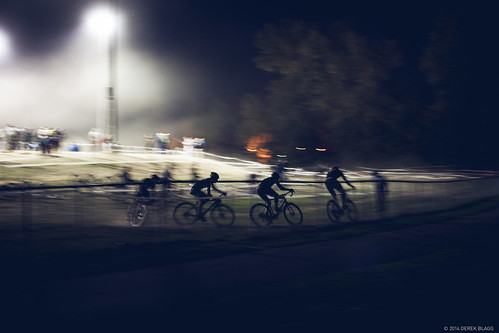
  I arrived early to the event to ensure plenty of course recon and pre-ride time. It was a hot day (upper 80s) but since we raced at 8pm, the temperature would luckily drop a little by then. The course was very similar to previous editions of the race, featuring a mixture of tight hairpins and longer straights the cut through and around the Marymoor velodrome in Redmond. Also, as usual for this race, the ground was hard, rutted, and dusty.
  The starting chute had been relocated to the backside of the course and dumped you into the dirt access road along the back of the velodrome. From here the course shot over a rough section of grass before a corner along the fence and out toward the front along another rough section. At the end of the straight the course popped over a small raise before a 90-degree turn to the left and another sprint over bumpy grass. This sprint ended with a small gravel/asphalt section that cut through the fence and a 180 to sprint back out toward the highway. A 90-degree left threw you in a straight heading right for one of the night spot-lights before a 180 and back toward the fence. Here an off-camber 90-degree right led into a long bouncy stretch along the team tents before a 180 and into the velodrome park again. A small climb up the embankment of the velodrome before a drop down the hill and a sharp 90-degree left up the hill over a series of log barriers. At the top of the logs it was immediately back on the bike and down the hill into a washed-out 90-degree left along with the entrance to the pits. Powering along the side of the velodrome, we would then race to the back entrance to the track and dump into the infield. A series of winding corners would trace along the infield before the finish-line sprint (very bouncy). After the line, the course hooked left and then right and shot the racers onto the velodrome track to race toward the front of the course. A tight right turn to reenter the infield before a sharp right and a straight into the beer-garden barriers. The sandy exit from the barriers led to the front track entry and we were back out of the velodrome. A few winding corners took us up and down the velodrome hill a few times before sprinting along the back grounds to the other entry of the pits. Here it was another 180 corner and then a short dusty sprint back to the access road to begin again.
  After a few pre-ride laps of the course, I definitely was remembering last year and how the course starts to wear you down. My legs were feeling strong and I was ready to race, however the ladies would have the course first. I spent my time warming up more, making sure I was hydrated and fueled, and psyched up for the hour of racing ahead of me. As I expected, the temperature started to drop as the sun went behind the horizon and darkness rolled in. My field began to line up outside the course, and it was again impressive to be part of a race featuring big names like Carl Decker (Giant Factory Racing), Zach McDonald (KCCX Elite Cyclocross), Barry Wicks and Spencer Paxson (Kona), Russell Stevenson (2013 35+ World CX Champion), and even Oregon framebuilder Ira Ryan. Since I am not a Pro or Cat 1 racer, I was happy with my 4th row starting position.
  At the gun, we were off. I had a good start and moved past some of the other racers in my area as we wrapped along the back of the course. We continued to haul ass along the course for the entire first lap, people battling for positions and working through the field of racers. I was definitely feeling fast and was rubbing elbows with some big racers. Even though I was running low pressure (~22psi) in my tires, and riding a titanium bike (which theoretically imparts some vibration relief), the course was bouncy and rough. The dust, which in the past has been near-blinding in some areas, was relatively light for our race, and I only really thought about it being dusty on the lead into the dirt access road that formed the back straightaway.
  The race started to fall apart on the 3rd lap, as the leaders broke free to form a crazy battle upfront for the huge prize. I continued to lay it out and managed to stay in the "main" group, roughly the 3rd bunch on the course. We were hustling to keep up the pace and make sure the riders behind us were struggling to keep in-sight. I was feeling strong and we continued at this pace for a few more laps, trading blows and slowly pulling further from the racers behind us.
  With a few laps to go I started to feel the fatigue. I could definitely tell that our group was slowing down and we started to make little mistakes. I dropped my chain by the pits and had to sprint back on, a racer unclipped mid-corner slowing everyone behind him, another rider slid out too far in a corner and caused some more slowing. I managed to clear some of the riders who fell out of power early, and managed to hold tough for a little longer. With about 2 laps to go, a racer strongly passed me, lighting a fire to chase him. I managed to do well holding him in for that lap, but starting the final lap my legs were feeling leaden. Heading toward the front of the course I was passed by another racer who I often benchmark off. I was disappointed that he got around me and that I was too gassed to chase him back. I just kept churning along to keep him in-sight and managed to finish slightly behind him, ending the race in 20th place of 30 finishers (9 DNFS). Given the mixture of the field, I am pretty happy with the result and hope to continue the season moving forward. Thanks to all the folks out there supporting me, and look forward to bringing in the big results for the rest of the races.
See you next week for Cross Revolutions #1 at Silver Lake.

September 9, 2014

MFG 2014 #1 - Lake Sammamish

  Well, here we are. The 2014 CX season has begun and I am again racing the best of the NW in the Elite category. Unlike the usual MFG starter at Big Finn Hill park in Juanita, we instead begin the season along the beautiful Lake Sammamish in Issaquah. A wonderful Summer spilled into the weekend with bright sunny skies and temperatures rising into the mid-high 80s - definitely feels like Summer-cross to me!
  With some construction in the park, the MFG crew chose to mix things up with an entirely new course with the added twist of running the opposite direction of the past editions. This lead to an entirely new course feel, although the running along the beaches retained the leg-sapping efficiency of earlier years. Utilizing the sporadic trees, rutted and bumpy grass fields, and three stretches of sand, the course was an ideal mix of technical maneuvering, power, and running finesse.

  Our Elite race began at the end of the day, ensuring that the sand was hardly ride-able and the looser off-camber sections were torn-up and rut-filled. Under the Summer heat, we lined up for the next hour of pain. I was lucky to receive a random call-up to start in the front row - a great way to start the season since it would mean less traffic in the early corners. As the whistle blew I clipped in and started to sprint down the stretch, only to have my starting foot pop loose (looks like it is time to tighten those pedal-releases)! I managed to clip in and get charging again, however I was now mixing it up at the back of the pack - so much for that call-up...
  Diving into the first corners, I worked my way past some racers and tried to move to the front of the race. As we hit the first section of sand I was able to quickly navigate the winding riders and move up further. This happened again shortly after during the second sand stretch which occurred almost immediately afterward. I then powered through the winding course as it negotiated the trees and off-camber hills on the way toward the beach. Running along the 3rd section of sand was guaranteed for all racers due to the sharp hairpin entry and churned, loose sand. This section of beach was also the longest and left you drained by the end. I made up a few more spots here before we turned back into the trees and shot back toward the main part of the park. Flying out of the trees into a bumpy section of grass, we passed the pits and make a 180 to enter the double barriers before another 180. I was making up ground and could see the leaders just ahead! A few more bumpy stretches and corners lead to the pavement for a drag-race through the start/finish and begin the next lap.
  Our laps were taking ~6 minutes, so we would end up completing 9 laps of the course. I managed to move up a little more over the next two laps before getting caught in complete no-man's-land and then getting caught by two racers behind me. We worked together for the next few laps, taking turns of ripping each others legs off as we raced along. This continued until lap 7 when I became unglued and began to yo-yo off the back. I managed to catch back on before lap 8 and then fall off again during the start of that lap. However, one of the riders messed up a corner and I then flew passed him. I was now chasing after the other rider (Mike Dicenso) and trying to catch his tail.
  As we entered the final lap, I was feeling drained from the heat and exertion, however there were only a few minutes of pain left - leave it all on the course! I powered along the course toward the fleeting figure up the road. I managed to pass another rider who was completely burned-out along the final sand section and felt like I was making great progress. Back out into the main field and I flew into the barriers a final time. I had a mounting hiccup and ran wider than I usually did, figuring it wouldn't be an issue. Unfortunately, another rider had caught up to me and used the bumble as a perfect opportunity to pass. I immediately noticed the blunder and powered along to hold his wheel. With only a minute of racing left I was struggling to hold on and once we hit the pavement and he was still leading I knew I wasn't going to catch him for this race. We screamed down the pavement and finished the first CX race of the season. My official finishing placing - 9th (3 minutes behind the 2 leaders of the race) of the 22 starters. Not a terrible way to start the season since that was my overall best placement in a race last season and here I was starting there.
  After some water (boy that was a hot race!) and cooling down, it was nice to chat with some of my competitors and look forward to a great season of racing. I was very happy with how my new On-One Pickenflick handled the course. The titanium frame was light for the long portaging across the sand, stiff under the continual accelerations, and comfortable over the rough and bumpy course. I guess the awesome Shimano Di2 and hydraulics couldn't have hurt the performance either!
  Next weekend is the big Starcrossed race, with the Elite race beginning at 8pm! That should be fun as the night race is always a crazy affair. See you then.